
If you are shopping for a home in The Bahamas, one of the first real decisions you will face is whether to build something new or buy an existing home. It is a fair thing to weigh, and a lot of buyers arrive with a habit carried over from the mainland: newer must be safer, so building new must be the better bet. That assumption doesn't always hold up.
New construction versus resale in The Bahamas is not a decision with a single right answer. It depends on three things: the island you are looking at, how quickly you need to move in, and how the insurance and long-term costs shake out for the specific property.
On some islands, there is very little resale inventory, so building is effectively your only route. On others, a well-kept existing home in an established neighbourhood will get you settled faster and with fewer surprises. The buyers who get burned are usually the ones who picked a side before checking either of those things.
Here is how the two paths actually compare, and a simple way to work out which one fits your situation.
TL;DR: New Construction vs Resale in the Bahamas
-
There is no universal winner. The right call depends on your island, your timeline, and the property's insurance and running costs.
-
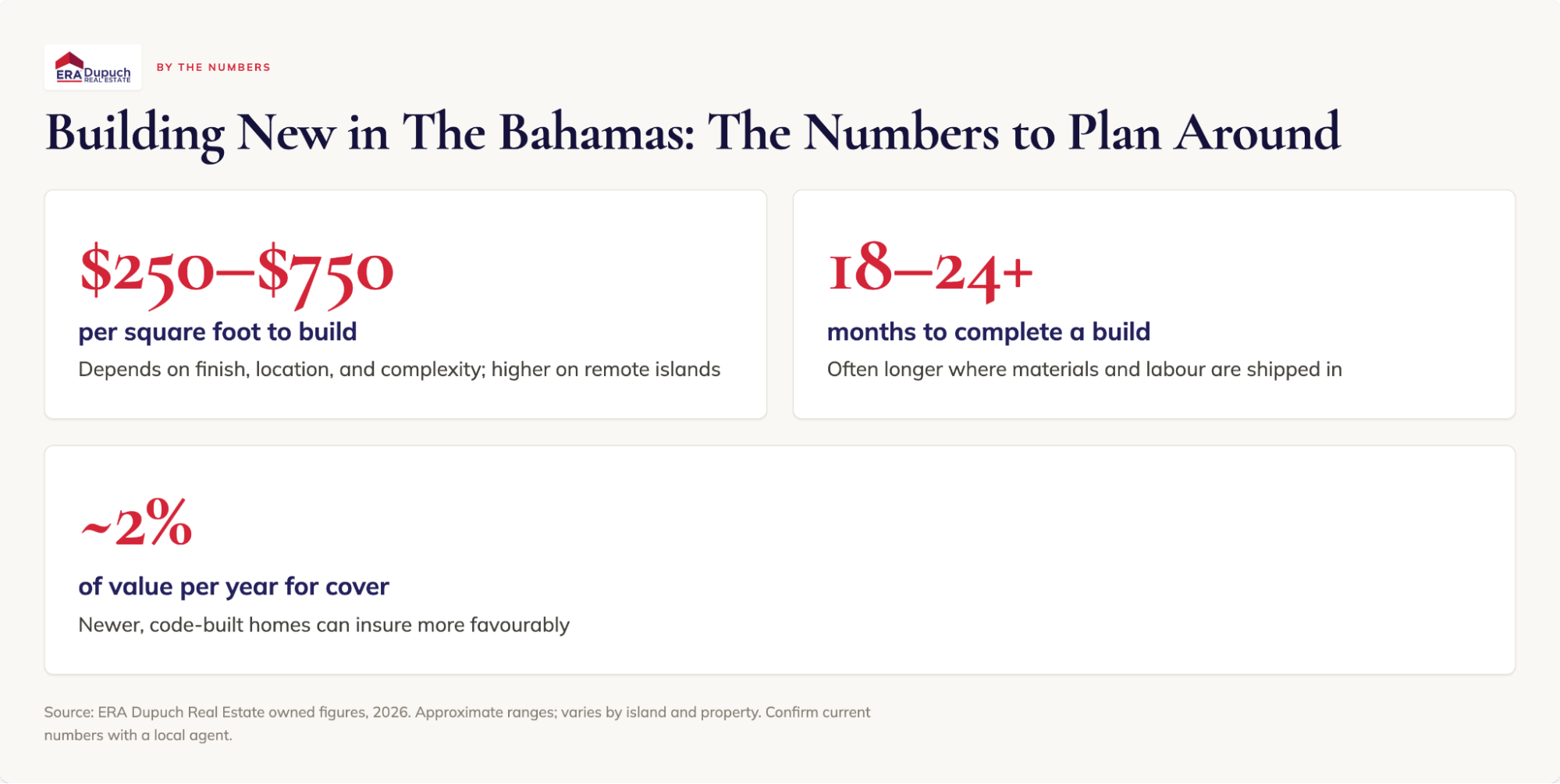
Building new runs roughly $250 to $750 per square foot and takes about 18 to 24 months or more. Resale gets you the keys on closing.
-
Newer, code-built homes can be insured more favourably, which matters a great deal in a hurricane market.
-
On thin-inventory islands, building is often the only realistic way to get the home you want.
Comparing New vs. Resale in The Bahamas
Resale is usually the smarter move if you want to move in quickly, spend a known amount, and buy into a neighbourhood that already has roads, utilities, and amenities in place.
New construction is usually the better fit if you want to design the home yourself, you want the insurance and maintenance profile of a newer build, or you have your heart set on an island where good resale listings are scarce.
That’s it in a nutshell. Everything below is about working out which of those two descriptions sounds more like you, because the honest answer changes from buyer to buyer and from island to island.
What "New Construction" and "Resale" Actually Mean Here
New construction in The Bahamas usually means one of two things: buying a lot and building a home on it, or purchasing a unit in a development that is still going up. Resale means buying a home that already exists, from the current owner, in an area that is already built out.
For most foreign buyers, the ownership rules are the same either way. If you are buying a single-family home or a condominium on less than two acres, you generally register the purchase after closing rather than seeking approval before it. The main exceptions that trigger a permit requirement are undeveloped land of two or more acres, property you intend to rent out, and commercial development.
So the foreign-buyer paperwork rarely decides this for you. What decides it is cost, timing, risk, and what is actually available where you want to live. If you want the full purchase process from offer to closing, see our guide to buying a house in the Bahamas.
Costs: What to Budget for Each Path
Building almost always costs more per square foot than buyers expect, and resale lets you see the price before you commit. That is the short version.
Right now, construction costs roughly $250 to $750 per square foot in The Bahamas, depending on the level of finish, the island, and the complexity of the build. A modest home sits nearer the bottom of that range; a beachfront villa with imported finishes pushes past the top, and fully custom luxury builds can run well past it. On top of the build itself, you budget for the lot, architectural drawings, permits, and duties on imported materials, since most building materials are shipped in.
Resale works differently. The price is on the table, financing tends to be more straightforward for a finished home, and there is less room for the budget to drift. Some sellers of new-build inventory will offer a discount to a cash buyer paying up front.
Either way, plan for the transaction costs associated with any Bahamian purchase. You pay your own attorney, around 2.5% of the price plus VAT on that fee. The agent commission, 6% on a developed home and 10% on undeveloped land, is normally the seller's cost. And there is VAT on the conveyance itself, a flat 10% for foreign buyers, usually split evenly between buyer and seller.
You can run different price points through our mortgage calculator, and one of our agents can give you current, island-specific numbers, because a build quote in Long Island and a resale price in Nassau are two very different things. For the full breakdown, see our closing costs and fees page.
New Construction vs. Resale at a Glance
Before we go section by section, here is the whole comparison in one place. There is no universal winner. The right path depends on your island, timeline, and budget.
|
Card |
Who it's for |
Property needed |
Government fees |
Term |
What it gets you |
|
Home Owner's Residence Card |
Anyone who owns a home here, at any value |
Own a habitable residence (no minimum value) |
~B$100 processing + B$500 issuance |
Renewed annually |
Entry and stay for you, spouse, and minor children on the home you own |
|
Annual Residence |
People who want to reside without buying at the permanent-residence threshold |
No property minimum; proof of means |
Set by Immigration; renewed yearly |
Renewed annually |
Legal residence, year to year |
|
Economic Permanent Residence |
Buyers who want lifetime status and a citizenship track |
Min. US$1,000,000 investment (US$1.5M for fast-track) |
~B$100 processing + B$20,000–$25,000 certificate + $300 per family endorsee |
Lifetime |
Permanent right to reside, family included, eligibility toward citizenship |
Timeline: Keys Now vs. Building for 18 to 24 Months
Resale gets you the keys on closing. New construction takes about 18 to 24 months, and often longer on the Family Islands, where crews and materials must be brought in by boat.
That is the single biggest practical difference between the two. If you are relocating for work, school, or a visa, or you want to start earning rental income soon, a resale home is the reliable choice.
If you are planning to have the property as a future retirement home or a second home and you are not in a hurry, the wait can be worth it for a place built exactly the way you want it.
Be honest with yourself about the timeline before you fall for a piece of land, because a build has a way of taking every bit of the two years you give it.
Hurricane Risk, Building Codes, and the Insurance Math
These are the things most buyers underweight. In a hurricane market, how a home is built affects both how it holds up and how much it costs to insure every year.
Newer homes built to current codes can be insured more favourably than older homes, which can add up to a good amount of savings over the long term. Plan for hurricane coverage in the region of 2% of a property's value per year, so a meaningful difference in premium adds up. That’s a point in favour of new construction.
It cuts the other way too, so keep reading. A newer home is not automatically bulletproof, and a well-built older home in the right spot can outperform a cheap new build. Elevation, drainage, and the flood zone matter as much as the age of the structure, and they cut across both paths.
Before you commit to any home, new or resale, one of our agents can help you read a specific property's elevation, flood zone, and likely insurance profile so that you understand exactly what you’re getting into.
Inventory Island by Island
Where you want to live may make the decision for you. On several of the Family Islands, there is very little resale inventory, so building becomes the only way to get the home you want.
On islands like Long Island and Cat Island, and in parts of Eleuthera and Exuma, it’s common to search and find nothing on the market that fits. In that situation, buying a lot and building is not really a preference; it is the only path available.
In Nassau, on Paradise Island, and in the built-out communities around Exuma, the picture flips. There are quality resale properties in neighbourhoods that already have security, utilities, beach access, and amenities you can’t easily reproduce on a bare lot.
The practical step is to check what already exists on your target island before assuming you have to build or buy.
Our team tracks what is available and what is coming, on the outer islands where public listings run thin. You can start by browsing current listings for the islands you are considering, from Exuma and Eleuthera to Cat Island and Nassau and New Providence.
Total Cost of Ownership: Looking Past the Sticker Price
The price you pay at closing is not necessarily the price you pay to own. Over a holding period, the two paths can look quite different from how they looked on day one.
An older resale home can carry higher running costs. Salt air is hard on a building, and in our experience, upkeep in The Bahamas can run anywhere from about $100 to $1,000 a month depending on the property.
Add the insurance premium for older construction, and a "cheaper" resale can cost more to own than it first appeared to. A new build flips that around: lower near-term maintenance, a warranty on the work, and a friendlier insurance profile, set against the long wait and the risk that comes with any construction project.
Resale value is worth a thought as well. A well-built, well-located home holds value on either path, but liquidity varies by island and price band. Something in an established Nassau community will generally be easier to sell than a one-off custom build in a remote spot, however beautiful that build turns out. If a future sale matters to you, factor it in now.
New Listings, $600,000 - $700,000



How to Decide What’s Right for You
You don’t need to overthink this. Line your own situation up against a few plain scenarios, and consider a few things…
-
If you need to live there within a year, or want rental income soon, buy resale.
-
If you want a fully custom home and you can wait 18 to 24 months, build.
-
If you have set your heart on a thin-inventory island, building may simply be your only option, so plan for it.
-
If you want a predictable cost and an established community with amenities already in place, buy resale.
-
If the insurance and maintenance savings of a newer, code-built home matter most to you, that points towards new construction.
Most buyers land clearly on one side once they weigh timeline, budget, and island choice together. When folks can’t decide one way or another, the tie-breaker is almost always what is actually available where you want to be, and that is worth checking against real listings rather than guessing.
So which of those scenarios sounds most like you, and have you checked it against whatis actually on the market where you want to live? One of our agents can determine which of these scenarios best fits your target island and current budget.
Contact us, and we will walk you through what is available today and what it would cost to build what you want tomorrow.
FAQs for new construction vs resale Bahamas
Is it cheaper to build or buy an existing home in The Bahamas?
Buying resale is usually cheaper and more predictable up front. Building runs roughly $250 to $750 per square foot before you add the lot, permits, and import duties, and costs can drift over an 18- to 24-month timeline. Building tends to make financial sense when you already own land, when you want something fully custom, or when there is little to no resale inventory on your island.
How long does it take to build a house in The Bahamas?
Plan for about 18 to 24 months, and often longer on remote islands, where materials and skilled labor must be brought in. A resale purchase, by contrast, is usually complete within a couple of months, and you take the keys on closing.
Do new-construction homes cost less to insure in The Bahamas?
They often can. Newer homes built to current codes tend to insure more favourably than older stock, and hurricane coverage runs in the region of 2% of a property's value per year, so the difference adds up over time.
Age is not the only factor, though. Elevation, drainage, and the flood zone can matter just as much, so it is worth checking a specific property's insurance profile before you decide.
Posted by Helen Dupuch onEnjoy this blog post? Click here to subscribe for updates
Leave A Comment