
Healthcare is one of the topics we get asked about most often from buyers seriously considering a move to the Bahamas. Before the price per square foot or the view from the veranda, people want to know: if something goes wrong, will I be taken care of here?
It’s a reasonable question. The Bahamas has a functioning, modernising healthcare system with notable strengths, particularly in Nassau. It also has real limitations, particularly on the smaller islands.
Where you land on that spectrum depends largely on where you buy, what you need, and how prepared you are.
This guide covers how the system works, which hospitals are worth knowing about, what insurance you will need, and why your choice of island matters more than most buyers realise.
Healthcare in the Bahamas
-
Nassau and Freeport have well-equipped public and private hospitals. The Family Islands have government clinics and limited services.
-
Private health insurance is not optional for expats. NHI Bahamas, the national insurance programme, covers primary care only.
-
For serious or highly specialised care, Miami is the practical destination. Plan for it before you need it.
-
Medicare and most U.S. domestic health insurance plans do not cover medical costs incurred in the Bahamas. Expect to pay upfront and seek reimbursement.
What Healthcare in the Bahamas Actually Looks Like
The short answer: better than most people expect, with caveats worth understanding.
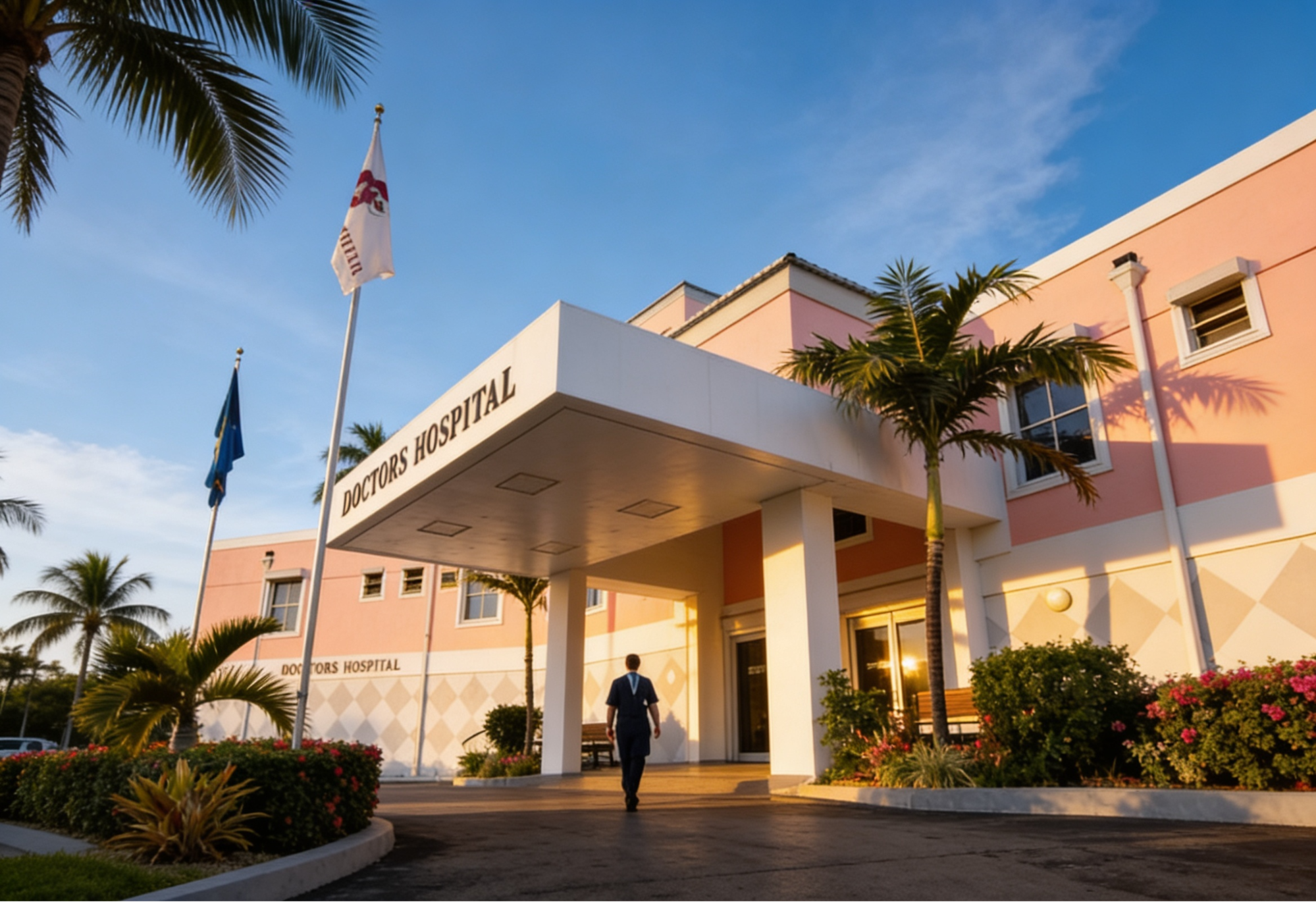
Medical staff at the Bahamas' private hospitals are often trained in the United States, the United Kingdom, and Canada. Facilities are typically modern and well-equipped. Doctors Hospital in Nassau holds Joint Commission International accreditation, the same standard used to evaluate leading hospitals in the U.S., making it the only JCI-accredited hospital in the country.
For routine care, specialist consultations, surgical procedures, and most emergencies, Nassau's private hospitals are fully capable.
Where the system stretches thin is complex, high-acuity care: advanced oncology, major cardiac surgery, complicated neurological cases. For those, Miami is the realistic option, and experienced expats plan accordingly. That is not a criticism of the Bahamas so much as a practical reality of living in an island nation, and one that good insurance coverage addresses directly.
For context on cost: medical procedures in the Bahamas typically run 30 to 50 percent less than equivalent treatments in the United States, which is part of why the country has developed a growing medical tourism market alongside its expat residential base.
The Two-Tier System: Public vs. Private
Healthcare in the Bahamas operates on a public-private model. The public system is managed by the Ministry of Health and Wellness through the Public Hospitals Authority.
Private hospitals and clinics operate alongside it, serving patients with private insurance or who can pay out of pocket. In Nassau and Freeport, both options exist. On the Family Islands, the picture is different.
Public Hospitals in the Bahamas
The Public Hospitals Authority oversees three public hospitals across the Bahamas.
-
Princess Margaret Hospital in Nassau is the main public facility and a teaching hospital. It is the largest hospital in the country and handles a wide range of general and emergency care.
-
Rand Memorial Hospital serves Freeport and Grand Bahama.
-
Sandilands Rehabilitation Centre, also in Nassau, focuses on mental health and geriatric care.
The practical trade-off with public hospitals: wait times can be long, particularly in the emergency department at Princess Margaret. Specialist availability within the public system is limited, and some procedures or consultations require referral to private facilities or overseas care.
For emergencies, public hospitals are accessible and functional. For scheduled or specialist care, most expats we work with use the private system.
Private Hospitals in the Bahamas
Doctors Hospital in Nassau is the benchmark for private care in the Bahamas. JCI-accredited and operating with approximately 72 beds, it covers cardiology, orthopaedics, general surgery, obstetrics and gynaecology, oncology, gastroenterology, ophthalmology, and more.
In 2025, Doctors Hospital opened a new 25-bed facility in Grand Bahama, improving access to private healthcare for buyers considering Freeport and the surrounding area.
Lyford Cay Medical Facility, also on New Providence, is a private hospital popular with expats living in the western corridor of the island. It provides general and emergency services as well as specialist care.
One thing to know about private hospitals in the Bahamas: they require upfront payment or confirmed insurance before non-emergency treatment. If you are insured, you will typically pay at point of service and seek reimbursement from your insurer afterward. Carrying a credit card with sufficient headroom for a hospital visit is standard practice for expats here.
Expert Tip: Buying in western New Providence puts you within a short drive of both Lyford Cay Medical Facility and Doctors Hospital. It is worth mapping that proximity before you finalise a purchase.
What Is NHI Bahamas, and Does It Cover Expats?
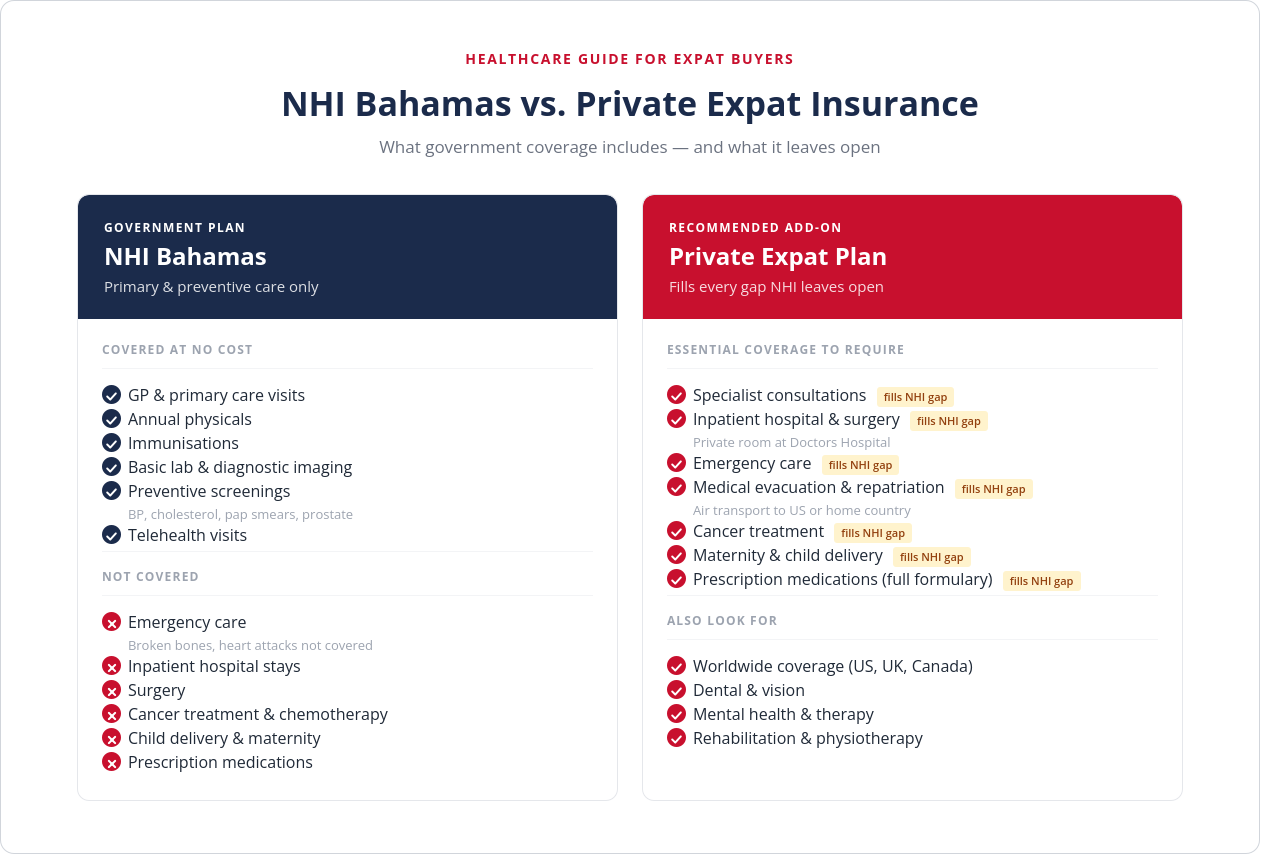
NHI Bahamas, formally the National Health Insurance programme and administered by the National Health Insurance Authority, is the government's public health coverage scheme. Launched in 2017, it gives residents access to primary care at no cost at the point of service. No copays, no deductibles for covered services.
As of 2025, more than 160,000 residents have enrolled. Full programme details, including a provider directory and enrolment information, are available at nhibahamas.gov.bs.
What NHI covers:
-
General practitioner visits
-
Annual physicals
-
Immunisations
-
Basic screenings, including blood pressure, cholesterol, pap smears, and prostate screenings
-
Lab and diagnostic imaging at participating providers
-
Telehealth visits
What NHI does not cover:
-
Emergency care, including broken bones and heart attacks
-
Inpatient hospital stays
-
Surgery
-
Cancer treatment and chemotherapy
-
Child delivery
-
Prescription medications
That second list is the important one for expats. NHI Bahamas was designed to make primary and preventive care accessible for residents, not to serve as comprehensive health coverage.
For most expats, it functions as a useful supplement, not a foundation. Legal residents of the Bahamas are eligible to enroll, and it is worth doing once your residency is in order. It should not, however, replace private insurance.
Health Insurance for Expats and Retirees
This is the area where we see the most buyers underestimate what they need.
Medicare and Medicaid typically are not valid at hospitals in the Bahamas. The U.S. Embassy in Nassau has confirmed that most U.S. domestic health insurance plans do not cover overseas medical costs and that hospitals may require an upfront deposit for non-emergency care, even when a patient holds U.S. insurance. In practice, you will likely pay the full cost at the point of service and seek reimbursement after returning to the United States.
What expats actually need is an international health insurance plan that covers inpatient care, specialist consultations, prescription medications, and, critically, medical evacuation and repatriation.
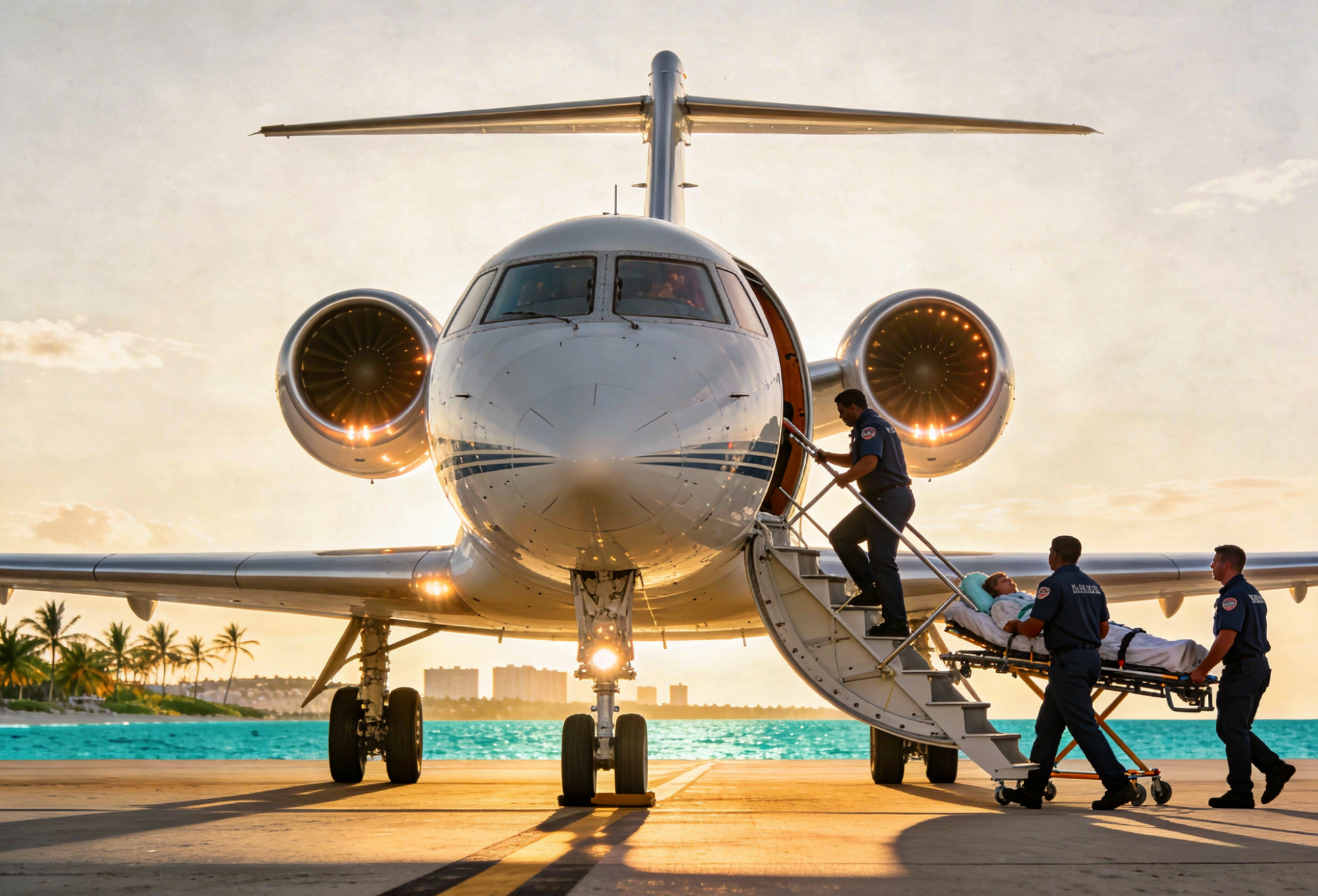
Evacuation coverage is not a nice-to-have. A medically equipped air ambulance from Nassau to Miami costs far more than most people budget for without insurance in place. That reality alone makes the case for getting coverage sorted before closing on a property.
Providers that offer international expat plans include Cigna Global, Allianz Care, and Aetna International, among others. We are not in a position to recommend a specific insurer, but we work with buyers on this regularly and can connect you with a broker who knows the Bahamas context well.
Expert Tip: Sort your insurance before you close, not after. It is one of those things that feels less urgent than it is, until it is not.
Healthcare by Island: Why Your Property Choice Matters
Where you live in the Bahamas determines what healthcare you can realistically access. The difference between islands is real, and it should factor into your decision.
Nassau and New Providence
Nassau offers the best access to healthcare in the Bahamas by a clear margin. Doctors Hospital, Lyford Cay Medical Facility, Princess Margaret Hospital, and a network of private specialist clinics and walk-in practices are all concentrated on the island. Routine care, specialist consultations, most surgical procedures, and most emergencies can be handled without leaving New Providence.
If something more serious arises, Nassau's proximity to Miami is a meaningful asset. Charter flights cover the distance in approximately 35 to 50 minutes. For buyers who want confidence that advanced care is within reach, New Providence is where that confidence is most justified.
Grand Bahama and Freeport
Grand Bahama's public option is Rand Memorial Hospital in Freeport. Private access is improving; like we mentioned earlier, Doctors Hospital just opened a new facility on the island in 2025. This adds cardiology, orthopaedics, and other specialties to a market that previously had limited private options.
Freeport remains a step below Nassau in overall healthcare access, but the trajectory is positive. Buyers considering Grand Bahama should factor in where the island is headed, not just where it stands today.
Abaco
Abaco has government clinics across its main settlements, including Marsh Harbour, with basic primary care services available. For anything beyond routine care, the practical plan is air evacuation to Nassau or, for serious cases, directly to Florida.
Expat buyers in Abaco typically plan regular trips to Nassau or Miami for specialist checkups. That is not a deterrent for everyone, but it is a logistical reality that buyers should understand before committing.
Exuma
The main government clinic in Exuma is in George Town, providing basic primary care for the island. Specialist services are not available locally.
Medical emergencies requiring more than basic stabilisation need air evacuation. The same planning approach that applies in Abaco applies here: build the logistics into your life rather than assuming Nassau-level access will be nearby.
Eleuthera and Harbour Island
Government clinics operate along Eleuthera's length, including in Governor's Harbour and Rock Sound. Harbour Island has a small clinic as well. Eleuthera is seeing growing buyer interest, and it is worth noting that the island's healthcare access remains at the clinic level. For anything beyond primary care, Nassau is the destination.
Other Family Islands
Andros, Long Island, Bimini, the Berry Islands, and the remaining inhabited Family Islands follow the same general pattern: small government clinics, basic services, limited hours, and air evacuation as the plan for emergencies.
Buyers drawn to the more remote islands for their privacy and pace of life should weigh the reality of access alongside everything else.
Expert Tip: We ask buyers who are retired or managing a chronic condition to think about healthcare access the same way they think about airport access. It is not a dealbreaker for everyone, but it needs to be part of the conversation before you commit to a location.
What Happens If You Need Specialist or Emergency Care?
For most day-to-day needs and moderate medical situations, Nassau's private hospitals manage well. The system is English-speaking throughout, which removes a barrier that complicates healthcare access in many expat destinations.
Where the Bahamas reaches its limits is high-acuity specialist care: advanced cancer treatment, complex cardiac surgery and major trauma. For those cases, Miami is the practical destination.
It is close enough that most Nassau-based expats treat it as a manageable reality rather than a crisis. The charter flight is short. What changes the equation is cost exposure without the right insurance.
Expert Tip: Make sure your residency documentation is in order before you need healthcare. Some private facilities will want to see your status when confirming insurance eligibility.
A Practical Checklist Before You Relocate
Getting your healthcare situation right before you move is straightforward if you work through it in order.
-
Purchase an international health insurance plan that covers inpatient care, specialist consultations, prescription medications, medical evacuation, and repatriation. Do this before you close on a property.
-
Check whether your current U.S. or Canadian health plan has an international rider. Most do not cover overseas medical costs.
-
Identify the nearest private hospital or clinic to the property you are buying.
-
Confirm that the medications you take regularly are available at pharmacies in the Bahamas. Many common medications are stocked; some are not.
-
Register with a general practitioner or private clinic in Nassau as soon as you arrive.
-
Enroll in NHI Bahamas once you have legal residency. It covers primary care at no cost and is worth having as a supplement.
-
Build a contact list: your GP, Doctors Hospital admissions, and a medical evacuation service.
The national emergency number in the Bahamas is 919, which connects to ambulance, police, and fire services.
Frequently Asked Questions
1. Do U.S. health insurance plans work in the Bahamas?
Most U.S. domestic health insurance plans do not cover overseas medical cost and facilities will likely require full payment upfront, with reimbursement handled after. Before relocating, confirm your plan's international coverage in writing, and assume that a separate international or expat health plan will be necessary.
2. Can I use Medicare in the Bahamas?
No. Medicare and Medicaid are not accepted at hospitals or clinics in the Bahamas. If you are relocating and rely on Medicare for your primary coverage, you will need to arrange a separate international health plan for care received outside the United States.
3. How do expats get health insurance in the Bahamas?
Expats typically purchase an international health insurance plan before relocating. The plan should cover inpatient care, specialist consultations, prescription medications, and medical evacuation to the United States.
Posted by Helen Dupuch on
Enjoy this blog post? Click here to subscribe for updates
Leave A Comment