
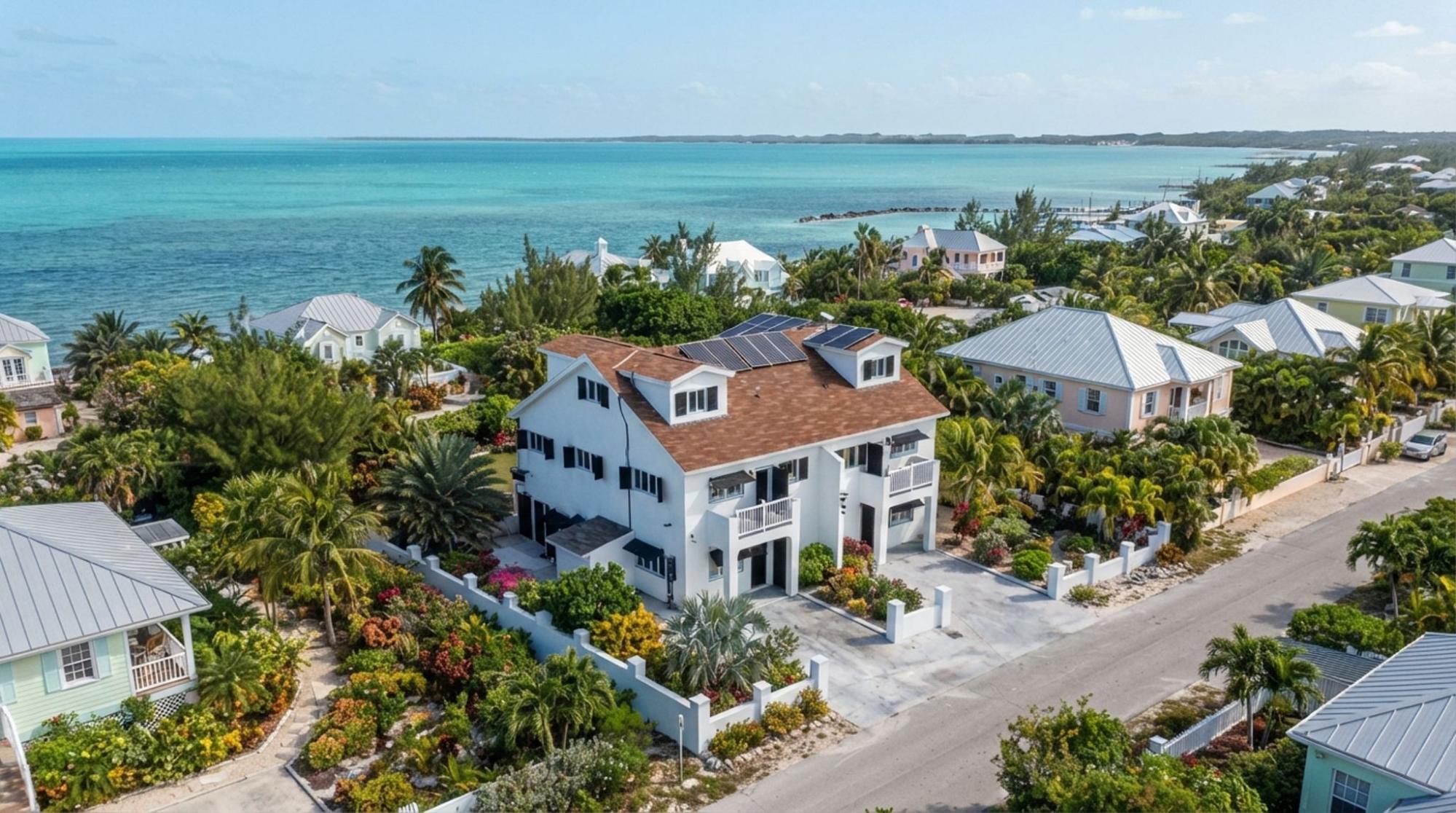
A duplex can be a wonderful investment property, and in the Bahamas the opportunities are abundant. You can choose to rent one side of the property (short or long term) and live in the other, rent both sides, live in both sides, or any combination.
Buying property in the Bahamas is pretty straightforward, but it’s helpful to understand what goes along with owning a rental property before you start looking. In this article we’ll cover: registration or permit, how rental income is taxed in a country with no income tax, what it costs to buy and hold, and how financing works for a foreign buyer.
TL;DR: Buying a Duplex in The Bahamas
-
Foreigners can buy a duplex in The Bahamas with the same rights as citizens. You don't need residency first.
-
A private home you'll live in only needs to be registered after purchase. A duplex you intend to rent, both sides or just one, requires a permit before you buy.
-
The Bahamas has no income tax and no capital gains tax. Short-term rental income is still subject to VAT, and a non-Bahamian owner also needs a Business Licence to rent a unit out.
-
Owner-occupied tax treatment now requires at least 90 days' occupancy per year for partial exemption, and 183 days for full exemption.
-
Foreign buyers can get local mortgages, though the deposit is usually larger than back home.
-
The details are where a duplex differs from a regular house, so get the permit and rental tax questions answered for your specific property first.
Can Foreigners Buy a Duplex in The Bahamas?
Yes, foreigners can buy a duplex in The Bahamas, and you do not need to become a resident before you do. Under Bahamian law, international buyers have broadly the same property rights as citizens, including the right to own freehold. That's a big reason the market is so open to buyers from the United States, Canada, and Europe.
A duplex is still a residential property. It's two dwelling units in one building, so the thing that sets it apart from a single-family home is how it's used.
If you want the wider picture of foreign ownership first, our guide to owning property in The Bahamas covers the basics that apply to any purchase.
Do You Register a Duplex, or Do You Need a Permit?
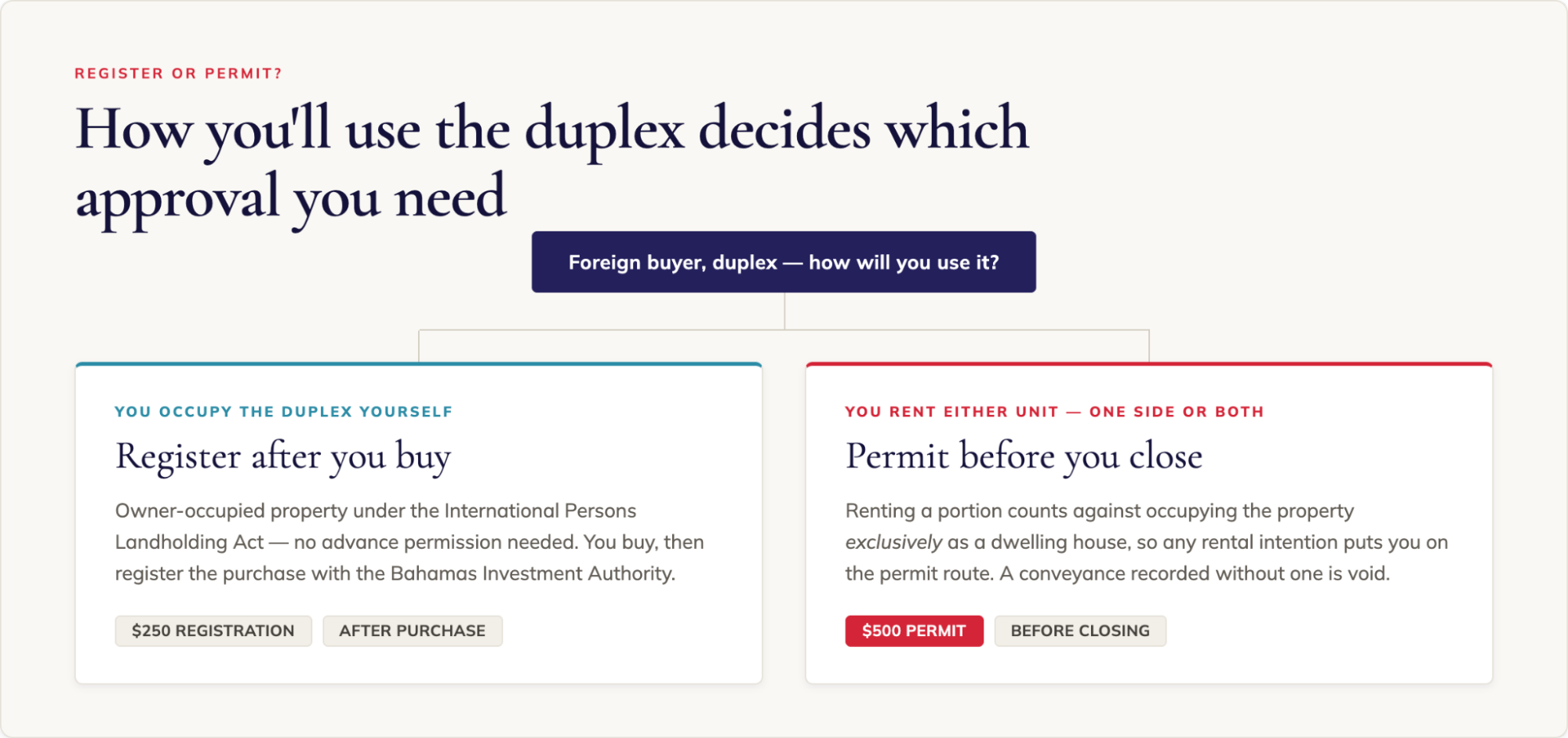
For a home you'll actually occupy, a foreign buyer usually doesn't need advance permission. Under the International Persons Landholding Act, if you acquire a condominium or property to be used as owner-occupied property, you don't need a government permit.
You buy the property and register the purchase with the Bahamas Investment Authority afterward. The same applies to vacant land you'll build an owner-occupied home on, unless the purchase would leave you holding two or more contiguous acres.
A permit is required before you buy anything that falls outside that description, and a conveyance recorded without one is void. That's where a duplex can fall into a different category than a regular home.
The Act defines owner-occupied property as property you occupy and reside in exclusively as a dwelling house, on a permanent or seasonal basis. Renting a portion of the property counts against "exclusively," so buying with the intention to rent either unit, the other side or both, puts you on the permit route. The registration shortcut is reserved for a building you'll occupy yourself.
The government fee is modest either way (registration is $250 and a permit is $500), so the real cost of getting this wrong is measured in time: a permit has to be sorted before closing, and permits tend to take time for approval.
One more provision worth knowing if your plans might change. When a permit is granted, it records the use you stated. Change that use later, and you'll need to apply to vary the permit, or it stops being valid. The exception is narrow but useful: no variation is needed where the change is from an exclusive dwelling house to property leased or rented on a seasonal basis.
If you're not sure whether you need a permit or not, speak to a local agent who has handled multi-unit purchases and can flag early which side of the line your property sits on, then let your Bahamian attorney confirm it in writing before you commit. Sorting this out at the start is far easier than discovering it at the closing table.
Renting Out a Unit: How the Income Is Taxed
The Bahamas has no income tax and no capital gains tax, so your rental income and any future gain on the property aren't taxed the way they would be in most home countries. For a duplex buyer planning to rent a unit, that changes the math considerably.
Three obligations still apply when you rent a unit out.
-
The first is VAT on rental income. Short-term and holiday letting is a VAT-able activity in The Bahamas, so you'll generally need to register with the Department of Inland Revenue and charge VAT on what you collect. A Bahamian individual only has to register once rental turnover passes $100,000 a year.
A non-Bahamian owner has to register regardless of turnover. You can collect the VAT yourself or authorise the platform listing your unit to collect and remit it for you.
-
The second is a Business Licence. Non-Bahamian owners need one to operate either a short-term vacation rental or a long-term residential rental. A Bahamian individual letting a property doesn't.
This catches people offguard, because a single annual lease to one tenant doesn't feel like running a business. But alas, it is. Applications go through Inland Revenue and need Bahamas Investment Authority approval first.
-
The third is the guest tax on short stays. Short-term rentals carry a 10% guest tax on the booking, charged on top of VAT, so build both into your nightly rate rather than absorbing them.
There's also a practical consideration that has nothing to do with tax. Many gated communities and condominium associations set their own rules on short-term renting, and some restrict or ban it. Check the community's rules before you count on vacation rental income from one side of a duplex.
A local agent who knows the neighbourhoods will steer you toward the ones that actually allow the rental plan you have in mind, which saves you buying into a building that won't permit it. Run the numbers both ways.
Living in one unit and renting the other can offset your carrying costs while you enjoy the place, and your own unit may still qualify for the gentler owner-occupied tax treatment. Renting both sides earns more, though either rental plan brings the permit question, VAT, and the property-tax classification into play.
How a Duplex Is Taxed Annually
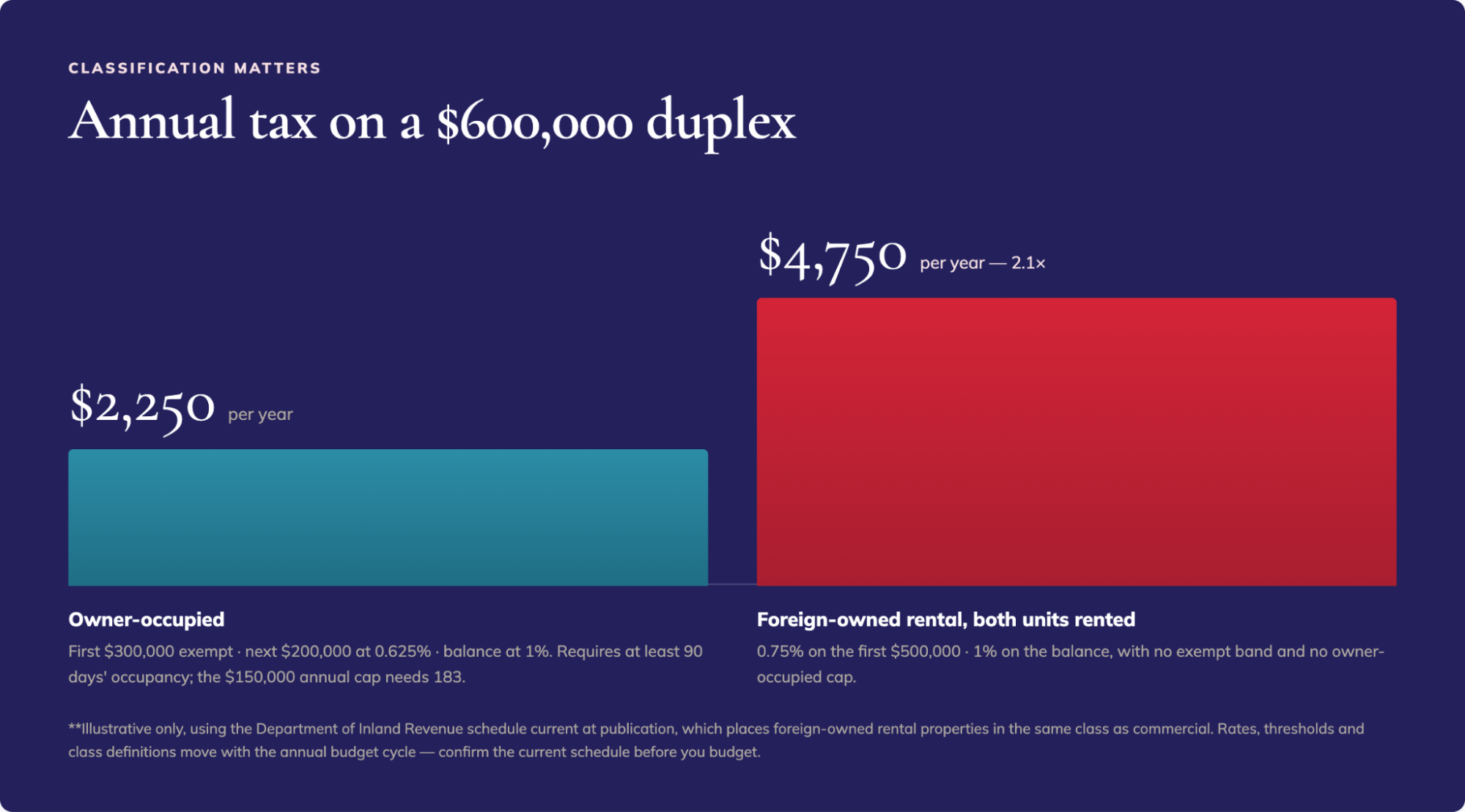
Your annual property tax bill depends on which class the Department of Inland Revenue puts your property in. Owner-occupied is the cheapest class, so the question that matters is whether your duplex counts.
To qualify, the property has to be your home and nothing else. The Real Property Tax (Amendment) Act, 2025, in force since 1 July 2025, sets two occupancy tests: live there at least 90 days a year to count as owner-occupied at all, and at least 183 days for your annual bill to be capped at $150,000.
Here's the duplex problem. "Your home and nothing else" describes a building you occupy entirely. Put a paying tenant in the other unit and the building is earning income, so it can be classified and taxed as an income property instead.
The 2026 budget legislation deals with this directly. It creates a separate class for foreign owners who live in their Bahamian property, with its own flat rate and annual cap, and it adds a rule written for duplexes, triplexes and fourplexes: the unit you live in is taxed at the owner-occupied rate, and the tax on the rented unit or units is capped separately. So the two halves of one building can be taxed differently.
Rates and thresholds move with the annual budget, so check the current schedule before you rely on any figure.
What It Costs to Buy and Hold a Duplex
Beyond the purchase price, budget for VAT on the conveyance, legal fees, agent commission, and annual property tax. Here's what each one looks like.
|
Cost |
Who pays |
What to expect |
|
VAT on the conveyance (transfer tax) |
Customarily split 50/50 between buyer and seller, but negotiable |
The rate changes based on the value of the transaction and on whether the buyer is an individual or a company. |
|
Legal fees (your Bahamian attorney) |
Buyer |
Customarily around 2.5% of the price, with 10% VAT added on the fee. Confirm with your attorney. |
|
Real estate commission |
Customarily the seller |
Set by agreement between seller and agent. |
|
Investments Board fee |
Buyer |
$250 to register a purchase, $500 for a permit. |
|
Annual real property tax |
Owner, yearly |
Depends on how each unit is classified. See the section above. |
The duplex-specific point is in that last row. How your building is classified, and whether its two units are classified the same way, drives the annual bill more than the purchase price does.
Ask your attorney to confirm how your specific duplex will be classified before you settle on a budget, and check the current schedule with Inland Revenue, since the rates and thresholds do change.
Financing a Duplex as a Foreign Buyer
Foreign buyers can obtain a mortgage from a Bahamian bank, so you're not limited to a cash purchase. What's different from what you might see at home is the down payment. Bahamian lenders set their own terms for foreign buyers and there's no single published national standard, so ask the lender directly and expect to put more money down upfront.
A rental-earning duplex can also be assessed differently from a home you'll occupy. A lender may weigh the projected rental income and the property's use when they structure your loan. If financing is part of your plan, start the conversation early.
Bank approvals for foreign buyers can take longer than the rest of the purchase, and they often become the step that determines your timeline.
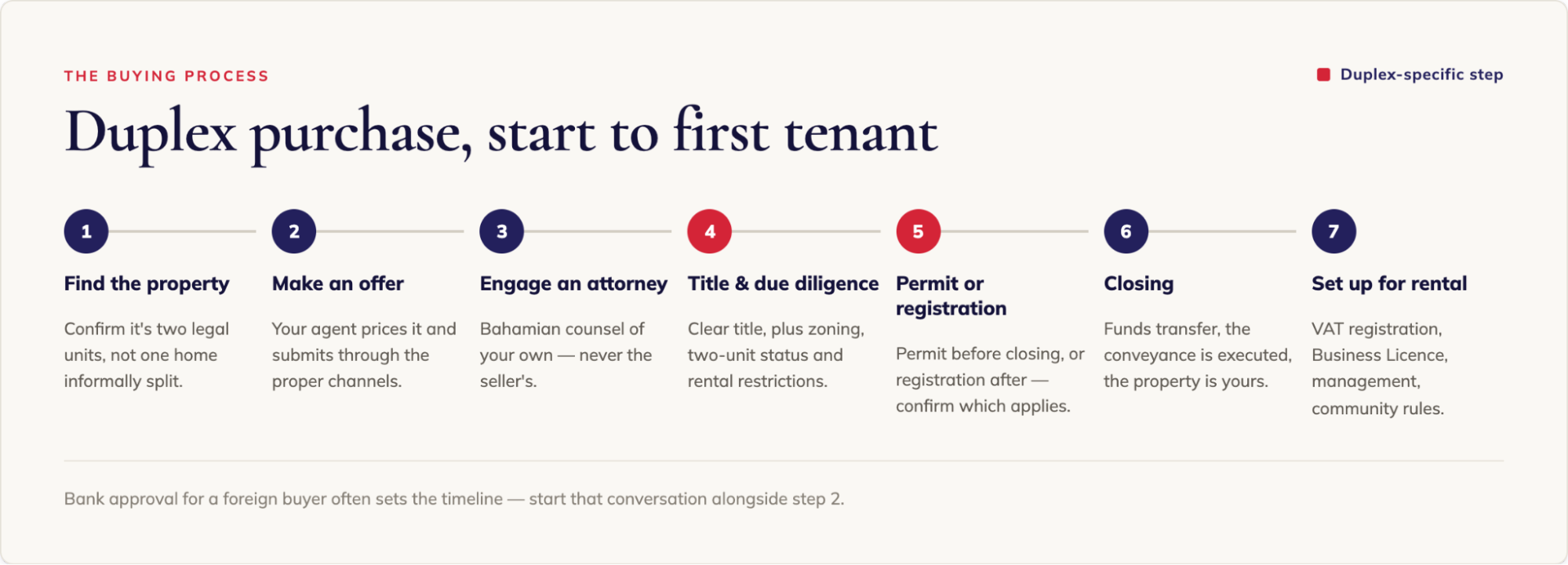
The Buying Process, Step by Step
This overall path will feel familiar if you've bought property before, with a few extra checks that apply for a two-unit property. Here's how it usually goes for a foreign buyer.
-
Find the property. Look specifically at duplex and multi-family listings, and confirm it's actually two legal units rather than a single home informally split. You can browse our current Bahamas listings and ask an agent to pull two-unit and multi-family options that fit your plan.
-
Make an offer. Your agent helps you price the offer and put it in through the proper channels.
-
Engage a Bahamian attorney. Do this early, and use your own attorney, never the seller's. They handle the legal work and the client checks that come before anything else.
-
Title search and due diligence. Your attorney verifies a clear title. For a duplex, this is also when you confirm zoning, the legal two-unit status, and any rental permissions or restrictions that affect your plan.
-
Government approval or registration. Depending on the permit-versus-register question above, this is either a permit obtained before you buy or a registration completed after. Confirm which one applies to your property.
-
Closing. Funds are transferred, the conveyance is executed, and the property becomes yours.
-
Set up for rental, if that's the plan. Register for VAT, apply for the Business Licence, line up management, and confirm the community allows your rental approach before you list a unit.
We help foreign buyers source and vet two-unit properties, connect you with trusted Bahamian attorneys, and run the multi-unit checks before closing, so you find out what applies to your duplex well before the closing table.
A duplex works well in a market with no income tax, especially when rental income helps support an owner-occupied unit. It also has more moving parts than a straightforward home, so the buyers who do best are the ones who pin down the permit, VAT, and property-tax questions for their exact property up front.
Ready to look at two-unit properties? Browse our Bahamas listings or contact one of our agents, and we'll help you find a duplex that fits your plan and walk you through what it takes to buy it.
FAQs for Buying a Duplex in The Bahamas
Can a US citizen buy a duplex in The Bahamas?
Yes. US citizens can buy a duplex in The Bahamas with the same ownership rights as Bahamian citizens, and you don't need residency first.
If you plan to rent out a unit, check whether that changes your approval requirements because a property bought to rent, in whole or in part, requires a permit before purchase.
Do I need a permit to buy a duplex, or just register it?
It depends on how you'll use it. Under the International Persons Landholding Act, property you acquire to occupy yourself is registered with the Bahamas Investment Authority after purchase.
A duplex you plan to rent sits outside that, and renting a portion counts the same as renting the whole building, so living in one side with a tenant in the other still means a permit before you buy. Have your attorney confirm which applies to your specific property.
Do I need a Business Licence to rent out one side of my duplex?
If you're a non-Bahamian owner, yes, and it applies to a long-term residential tenant as much as to short holiday stays. You'll also need to register for VAT regardless of how little the unit earns, since the $100,000 turnover threshold only shelters Bahamian individuals.
Can Canadians and other non-US foreigners buy a duplex in The Bahamas?
Yes. The Bahamas welcomes buyers from Canada, Europe, and elsewhere on the same broad terms as US buyers. The ownership rights, the permit-versus-register question, and the local tax treatment work the same way regardless of your home country.
Your own country's tax rules on foreign property and rental income are a separate matter to check at home.
Does buying a duplex help me get residency in The Bahamas?
Property ownership can support a residency application, and an investment of $1,000,000 or more can qualify you for economic permanent residency, a threshold raised from $750,000 on 1 January 2025 and now tied to a ten-year holding requirement.
A more modestly priced duplex will usually sit below that figure, so don't assume the purchase alone grants residency. It can still support an annual homeowner's residence card. Confirm the current requirements with the Bahamas Department of Immigration.
*This blog is for general information only. We are not certified to give tax or legal advice. Rates and rules change, so please confirm any tax, VAT, permit, licensing, or residency specifics with a qualified Bahamian attorney and the relevant government authority before you buy.
Posted by Helen Dupuch onEnjoy this blog post? Click here to subscribe for updates
Leave A Comment