
If you've been reading about Bahamas permanent residency, you've probably run into a big, intimidating number: a million dollars, invested through a special programme, arranged by an immigration consultant. This is certainly one way to obtain permanent residency in the Bahamas. It's also, for a lot of buyers, more than you actually need.
Here's the part that not every article online will tell you. In The Bahamas, residency follows property. The moment you own a home here, you can apply for a Home Owner's Residence Card, no matter what the property is worth. Full Economic Permanent Residence, the lifetime status that puts you on the road to citizenship, is a separate and pricier step that only some buyers want. Knowing which one you're actually after will change your plan of action.
We've helped many international buyers make this move, so this guide walks you through it the way we'd talk you through it in the office: which residency card fits your plans, what it really costs, the tax realities, and how to apply.
Disclaimer: this is general information, not legal or tax advice. Immigration thresholds and fees change (they changed in 2025), so confirm the current figures with the Bahamas Department of Immigration or your attorney before you rely on them.
TL;DR: Bahamas Residency for Property Buyers
-
A Home Owner's Residence Card is available to any non-Bahamian who owns a home here, at any value, for modest government fees.
-
Full Economic Permanent Residence now requires a minimum US$1,000,000 real estate investment (up from $750,000 on 1 January 2025), with accelerated review for investments of US$1,500,000 or more.
-
There's no minimum stay requirement, so you don't have to live here full-time to keep your status.
-
The Bahamas charges no income, capital gains, or inheritance tax. If you're a US citizen, that does not cancel your US tax obligations.
Do You Actually Need Permanent Residency to Live in The Bahamas?
For many foreign buyers, no. Owning Bahamian property already gives you a route to legal residency through the Home Owner's Residence Card, and that comes with any purchase regardless of price.
This is where a lot of the online advice pushes people toward the most expensive door. The citizenship-by-investment firms lead with Economic Permanent Residence, the million-dollar programme, because that's the product they sell. It's a real option, and for some buyers it's the right one. For a second-home owner who visits often and simply wants to come and go freely, it can be far more than the situation calls for.
The Bahamas has long welcomed foreign owners, and non-Bahamians (including Americans) can buy here with broadly the same rights as citizens, except for a permit requirement for very large or multiple holdings.
So the first question isn't "which programme do I enrol in?" It's "What do I want residency to do for me?" If you want to understand what owning here involves first, our guide on owning property in The Bahamas covers the ground, and if you're wondering whether Americans can own at all, we answer that here.
The Three Ways Foreign Buyers Get Residency
There isn't one Bahamas residency. There are a few, and picking the right one saves you real money and paperwork. Most foreign buyers are choosing between three.
|
Card |
Who it's for |
Property needed |
Government fees |
Term |
What it gets you |
|
Home Owner's Residence Card |
Anyone who owns a home here, at any value |
Own a habitable residence (no minimum value) |
~B$100 processing + B$500 issuance |
Renewed annually |
Entry and stay for you, spouse, and minor children on the home you own |
|
Annual Residence |
People who want to reside without buying at the permanent-residence threshold |
No property minimum; proof of means |
Set by Immigration; renewed yearly |
Renewed annually |
Legal residence, year to year |
|
Economic Permanent Residence |
Buyers who want lifetime status and a citizenship track |
Min. US$1,000,000 investment (US$1.5M for fast-track) |
~B$100 processing + B$20,000–$25,000 certificate + $300 per family endorsee |
Lifetime |
Permanent right to reside, family included, eligibility toward citizenship |
Fees above are from the Bahamas Immigration fee scale and the Home Owner Identification page; confirm the current schedule when you apply.
Homeowner's Residence Card
If you own a home in The Bahamas, you can apply for a Home Owner's Residence Card no matter what the property is worth. It's the entry point most buyers start with. It lets you, your spouse, and your minor children enter and remain here for the life of the card, and you renew it each year for a modest fee.
It's designed to smooth your entry rather than grant full resident status, so it doesn't put you on the citizenship track. For a second-home owner who visits regularly, it's frequently all you need.
Annual Residence
Annual Residence suits someone who wants to live here without buying at the permanent-residence threshold. You apply, show you can support yourself, and renew it yearly. It's a holding pattern more than a destination, useful while you decide whether to commit to permanent status.
Economic Permanent Residence
This is the one people usually mean by "Bahamas permanent residency." It's a lifetime status tied to a qualifying property investment; it covers your family, and it's the path that can lead toward citizenship over time. It's also the one with the serious price tag, so it's worth being precise about the number.
The Economic Permanent Resident Investment Threshold
Economic Permanent Residence now requires a minimum investment of US$1,000,000 in Bahamian real estate (or in Central Bank Zero-Coupon Bonds), held for at least 10 years. Invest US$1,500,000 or more and your application qualifies for accelerated review.
If you've seen a lower figure floating around, that's because the minimum was US$750,000 until 1 January 2025, when the government raised it to a million. Many guides still cite the old number. The current requirements are set out by the Bahamas Department of Immigration.
If lifetime permanent residency is genuinely your goal, the higher your investment, the faster and smoother the process runs. When a buyer tells us residency is part of the plan, we line up homes at the level that qualifies for the outcome they want, whether that's a straightforward Home Owner's Card or the full million-dollar route.
You can browse homes in that range with us and know the residency box is handled.
What It Costs Beyond the Property
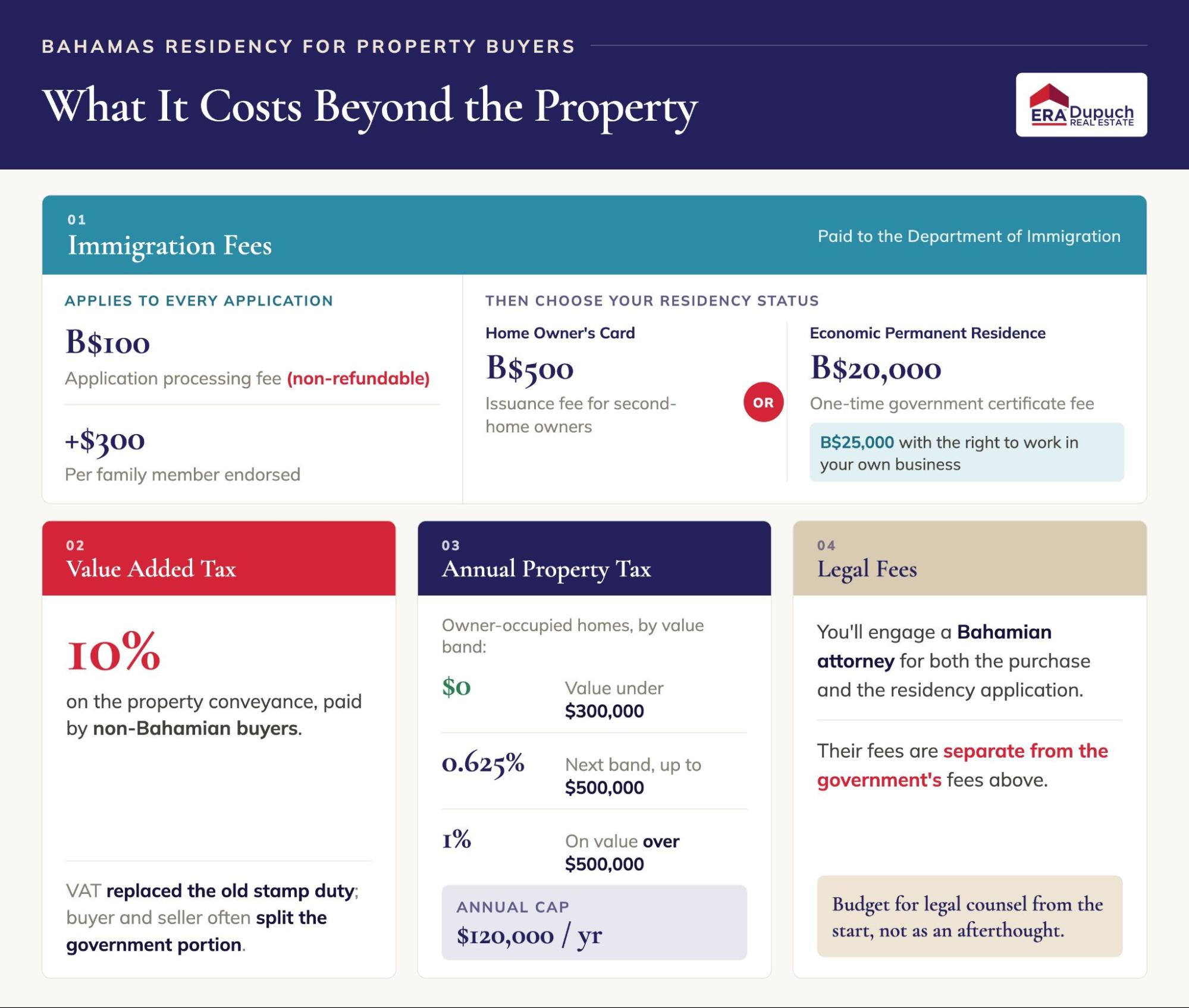
The purchase price is one thing to consider, but a few other costs come with buying and applying for residency in the Bahamas, and you'll want them in the budget from day one.
-
Immigration fees. A non-refundable processing fee of about B$100 applies to residency applications. The Home Owner's Card adds a B$500 issuance fee. An Economic Permanent Residence certificate carries a one-time government fee of roughly B$20,000, or B$25,000 if you want the right to work in your own business, plus $300 for each family member endorsed. See the Immigration fee scale for the current schedule.
-
Value Added Tax on the purchase. Non-Bahamian buyers pay 10% VAT on the property conveyance (VAT replaced the old stamp duty), and buyer and seller often split the government portion by agreement. Our breakdown of Bahamas closing costs and fees lays this out.
-
Annual real property tax. Owner-occupied homes worth under $300,000 pay no property tax. Above that, the rate runs 0.625% on the next band and 1% on value over $500,000, capped at $120k per annum. The specifics live in our guide to tax in The Bahamas.
-
Legal fees. You'll engage a Bahamian attorney for the purchase and for the residency application, and their fees are separate from the government's.
The Tax Question
Yes, the Bahamas charges no income tax, no capital gains tax, and no inheritance tax, and rental income earned here is currently tax-free. And it's a big part of why buyers look to own here.
However, it’s important to remember that if you're a US citizen, residency in the Bahamas does not exempt you from US taxes. The United States taxes its citizens on their worldwide income no matter where they live, so becoming a Bahamas resident doesn't switch off your US filing obligations. The Bahamas being tax-neutral is a real benefit; just remember it doesn’t necessarily mean you’ll be living tax-free.
We are not certified to give tax advice, and this is general information only. For anything specific to your situation, especially cross-border, talk to a qualified tax professional in your home country.
Bahamas Minimum Stay and Tax Residency
No, there's no minimum stay requirement to hold Bahamian residency. You can keep the status without living here full time, which is part of why it appeals to people who split the year between countries.
Worth separating two ideas that get muddled: holding a residency card is not the same as being tax-resident. Where you owe tax depends on your own country's rules and how much time you spend in each place, not simply on holding a Bahamian card.
If your goal is to change your tax residency, that's a conversation for a cross-border tax adviser, and it's a different question from getting the residency card itself.
How to Apply, Step by Step
The process is more straightforward than the paperwork makes it look, especially with an agent and attorney who've done it before.
-
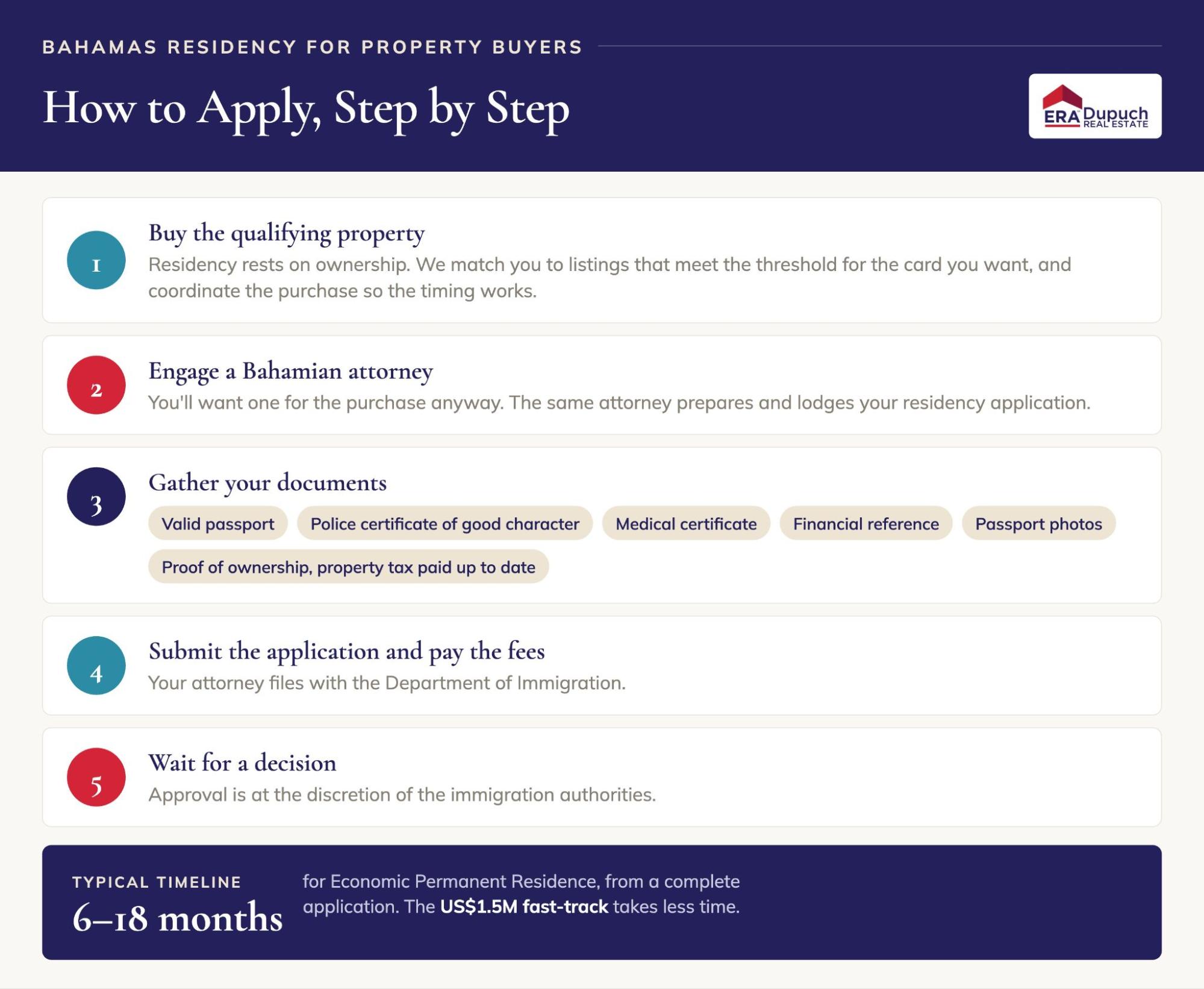
Buy the qualifying property. This is step one, because the residency application rests on it. When residency is part of your plan, we match you to listings that meet the threshold for the card you want and coordinate the purchase so the timing works.
-
Engage a Bahamian attorney. You'll want one for the purchase anyway; they also prepare and lodge the residency application.
-
Gather your documents. Expect to provide a valid passport, a police certificate of good character, a medical certificate, a financial reference, passport photos, and proof of your property ownership (the conveyance) with real property tax paid up to date.
-
Submit the application and pay the fees. Your attorney files with the Department of Immigration.
-
Wait for a decision. Approval is at the discretion of the immigration authorities.
On timing: commonly cited estimates put Economic Permanent Residence at roughly 6 to 18 months from the completion of the application, with the US$1.5M fast-track taking less time. The Department of Immigration doesn't publish a fixed timeline, so treat those as estimates, not promises. It depends on your file and the current queue, and we can talk through a realistic read for your situation.
The Honest Downsides
Island life is wonderful, but it isn't frictionless. The cost of living runs higher than many buyers expect, because so much is imported. Getting things done can move at "island time," which is charming on holiday and occasionally frustrating when you need a contractor. And hurricane season is a real part of the calendar you plan around, not a detail.
We cover the trade-offs candidly in what living in The Bahamas is really like, because a buyer who knows what they're signing up for is a happier owner than one sold a postcard.
For a lot of our clients, residency turns out to be the easy part once the right home is sorted. If that's the position you'd like to be in, we can point you to qualifying homes and connect you with the attorneys who handle the applications.
Talk to an ERA Dupuch agent about which residency path fits the purchase you're considering.
FAQs for Bahamas Permanent Residency
Can a US citizen live permanently in The Bahamas?
Yes. A US citizen can live in The Bahamas by owning property and holding the corresponding residency, ranging from a Home Owner's Residence Card to full Economic Permanent Residence. Americans can buy Bahamian real estate with broadly the same rights as citizens, then apply based on that ownership.
How much do you have to invest in property to get permanent residency?
For a Homeowner's Residence Card, there's no minimum property value. For full Economic Permanent Residence, the minimum investment is US$1,000,000 in real estate (up from $750,000 as of 1 January 2025), with US$1,500,000 qualifying for accelerated review, per the Bahamas Department of Immigration.
Does The Bahamas allow dual citizenship?
Generally, no, for adults. The Bahamas does not recognise dual citizenship for adults, so someone who becomes a Bahamian citizen is normally required to renounce their other nationality (there's a limited exception for those who acquire two nationalities at birth, up to age 21), per the US Embassy in Nassau. This only matters if you pursue citizenship. Residency does not affect your existing nationality, so holding a Bahamas residency card doesn't ask you to give anything up.
Do you pay income tax as a Bahamas resident?
No, the Bahamas has no personal income tax, so residents don't pay Bahamian income tax on their earnings, and there are no capital gains or inheritance taxes either. If you're a US citizen, though, you still owe US tax on your worldwide income regardless of your Bahamas residency.
Posted by Helen Dupuch onEnjoy this blog post? Click here to subscribe for updates
Leave A Comment